
TESTING THE WATERS: The Roots and Fruits of the Driftless Area Water Study

Updated: Sep 1
The Land
I've yet to meet anyone who is not awed by the beauty of our area, with rolling hills, babbling brooks, and winding rivers cutting through a patchwork of forests, fields, and small towns. The next thing many people comment on — and the first thing I miss whenever I travel — is the water. It tastes so good. And indeed, we are blessed to live in a zone that recharges and draws from one of the most abundant aquifers in the world. But how good is the drinking water, really? Until recently, we had almost no way to tell.
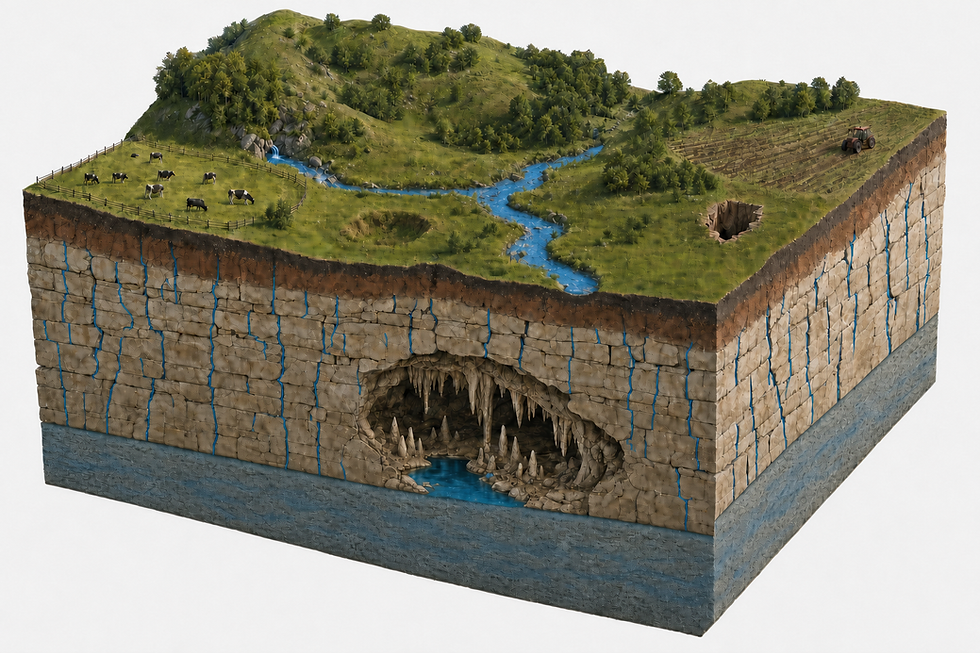
Crawford County sits atop ancient carbonate bedrock — dolomite and limestone, dissolved over millennia into complex and interconnected fracture patterns that channel water through it quickly, like a sieve. This is "karst geology." Sinkholes, disappearing streams, and other karst features form direct conduits to the groundwater, feeding into the aquifer or re-emerging in one of the abundant springs or streams we so appreciate.
The Water
The same slopes and karstic landscape that we love about this area also create challenges for keeping our shared water safe and clean. Most pollution cannot be seen, smelled, or tasted — the only way to truly know the quality of water in your well is to test it, ideally in a certified lab.
Crawford Stewardship Project is eternally curious about our water, and in 2017 I began to reach out to the counties, the university system, and state agencies. Back then we were told that there were almost no issues with nitrates in the county — but we also learned that less than 1% of wells in Crawford County had ever been tested, which meant that claim, and any claims about water quality, were essentially baseless. We also learned that fifteen other karstic counties in southeastern Wisconsin were slated to receive special groundwater protections, but not southwest Wisconsin's equally — perhaps more — vulnerable area, because there was not yet sufficient well testing to demonstrate need.
This was frustrating to hear. Groundwater is the number one conservation priority for the people of Crawford County, who wants to wait until a health crisis materializes before taking action? That makes no sense, especially given that our sandstone aquifer, once polluted, could take many generations to flush out.

Private wells are the best sources we have for information on regional groundwater, and when Crawford Stewardship Project started to investigate, we found guidance and inspiration everywhere. Many Wisconsin counties had done or were in the process of collaborative well testing programs, and one of our long-term partners, Steve Oberle, had led many years of such campaigns as County Conservationist in Taylor County. In portions of Vernon and Crawford counties, the Tainter Creek Farmer-Led Watershed Council was already starting to test wells.
From a Shoestring Budget to a Regional Study
What could we, a small nonprofit operating on a shoestring budget, do to fill this information gap?
With Steve's guidance, we started small — board members testing their own wells in 2018 to learn the ropes. Having done that, in 2019 we launched our "Groundwater Testing and Education Campaign," fully funding testing for 57 wells across the county on a first-come, first-served basis, working with the UW-Stevens Point Center for Watershed Science and Education (UWSP CWSE) and their Water and Environmental Analysis Lab (WEAL). These early participants helped us get a first view of local water quality, confirming that most wells in the area produce excellent water, while also revealing several impacted wells coming in far above the health standard for nitrates, and a fair number with bacteria.
While this was an excellent start, we knew we needed to find more partners and expand our scope if we really wanted to answer the question of what is in our water. We grew the scope to include Vernon and Richland Counties, which share similar topography and geology.
In 2020 the tri-county Conservation and Health Departments came together with Crawford Stewardship Project and other local organizations to form the Driftless Area Water Study (DAWS), with the objective of testing 400 wells that autumn and again the following spring. Our shared goal, proposed at one of our early meetings by Robert Nigh of the Farm Bureau: "Safe water for all!"
These tests were a success, despite COVID knocking our Health Departments out of the project almost completely, and with no external funding to rely on. I loved coordinating between the lab, the county partners, and the volunteers to bring such an important collaboration to life. From mapping out logistics at long, pizza-fueled meetings to the trips to deliver samples to the lab in Stevens Point, everyone pitched in just enough to make it happen — on a shoestring, in the middle of a pandemic.
With counties covering 50-100% of testing costs, we garnered excellent participation and DAWS soon captured attention. State legislators attended DAWS meetings, local newspapers covered the results, county boards and staff stayed informed, and our educational events brought findings directly to the public.
The 2026 Round
The Driftless Area Water Study partnership has continued ever since, testing 50-100+ wells in each county most years. There have been plenty of bumps in the road, and funding has been a continual challenge for a project of this importance.
For 2026, Crawford Stewardship Project was able to secure significant external grant funding, allowing the DAWS team to undertake our most comprehensive effort yet: testing 352 wells free of charge across all three counties, not only for the standard parameters of nitrates, coliforms, and E. coli, but for a wide range of metals and minerals as well — from generally harmless iron, magnesium, and zinc to potentially dangerous lead, uranium, and arsenic.

What We Found
The overall picture is reassuring: our water is generally good, shaped by the same carbonate bedrock chemistry that gives our springs their character and their taste. High mineral content — what makes local water "hard" and occasionally tough on appliances — is natural and expected here. But the results also show us some things to pay attention to.
Nitrates are a growing concern around the state, and a closely watched parameter. In 2026, 27% of sampled wells showed no detectable nitrate at all, and most wells fell well below the health standard of 10 milligrams per liter. But 4% of wells exceeded that threshold, and four wells came in above 20 mg/L — more than twice the health standard. That represents a real health risk, particularly for infants and pregnant people, who are the most vulnerable to high nitrate exposure. Nitrates enter groundwater from multiple pathways: fertilizers, manure, septic systems, and naturally occurring soil nitrogen are all potential sources, and in karst terrain — where surface water can reach a well in a matter of hours — what happens on the surface matters. Across our regional map, wells in areas with more intensive land use showed elevated rates compared to those in less developed areas.
About 11% of sampled wells showed the presence of coliform bacteria — microorganisms whose presence indicates contact between the well water and the surface environment. Two wells tested positive for E. coli, a more specific indicator of fecal contamination, and greater health risk. These findings are often connected to well construction or maintenance issues — a cracked casing, a loose cap, or an aging well liner — rather than to widespread problems in the aquifer.
This was the first large-scale DAWS round to include testing for a broad suite of metals, and it opened up a new layer of understanding about what is in our water. For most participants, the picture was benign — the natural mineral fingerprint of our limestone landscape. But establishing that baseline is precisely the point. Some metals, like arsenic and lead, can occur naturally in certain geologic settings and pose health risks at elevated levels, with no taste or odor to signal their presence. Knowing what is in your water now is what makes it possible to notice if something changes later. We will be sharing more about specific metals findings — and what they mean — at our public events this summer.
Why a Map of Our Water Matters
Beyond what it means for individual households, this data allows our local decision-makers and technical staff to move from guesswork to evidence. Through the Driftless Area Water Study, we are not just testing wells — we are building a map of our shared groundwater that will inform the stewardship of this region for generations.
Each well added to the dataset is a data point in that map, and the map starts to answer questions that no single test can. Where are elevated nitrate levels clustering, and what does the landscape around those wells look like? Where has bacteria contamination appeared across multiple rounds of testing, and what might explain it? Are the metals we are finding the signature of natural geology, or something else?
This kind of regional picture is exactly what local planners and officials need. Comprehensive land use plans, land and water management documents, and source water protection plans are designed to be grounded in evidence — but until recently, groundwater evidence for this region was almost entirely absent. DAWS data can now inform where buffer protections matter most, and where county conservation and health resources are needed.
The temporal dimension matters as much as the geographic one. A single round of testing tells you what the water is doing now. Multiple rounds — returning to the same wells, year after year — can reveal whether conditions are improving or worsening, and why. That is when data stops being a report card and becomes a genuine tool for long-term stewardship of a place we all depend on.
"Safe water for all" may sound like a distant goal, or perhaps simply like what you assumed we already had. Either way, it will only be achieved by understanding the complex groundwater system we live on, and acting accordingly.
Come Find Out — Free Public Events
Whether you participated in this or previous rounds of testing, or are simply curious about the water you drink, we hope you will join us at one of our upcoming public events. Come and hear experts map the invisible and explain the many factors that shape our groundwater.

VERNON COUNTY & VIRTUAL Tuesday, June 9 | 12:00 PM County Board Room (3rd Floor, Annex Building) 400 Courthouse Square, Viroqua, WI
RICHLAND COUNTY Thursday, June 25 | 5:30 PM Richland Center Community Center 1050 N. Orange Street, Richland Center, WI
CRAWFORD COUNTY Saturday, June 27 | 4:00 PM Gays Mills Community Commerce Center 16381 State Hwy 131, Gays Mills, WI
Free and open to all. Refreshments provided.
What to expect: Experts from the UW-Stevens Point Center for Watershed Science and Education will break down regional results for nitrates, bacteria, metals, and more. See our new Driftless karst groundwater simulator in action alongside our existing sandstone model — a hands-on way to visualize how water moves through the layers beneath your feet. Get practical tips on well maintenance and keeping your water safe.
A few recommendations for a water health checkup at home:
Test your well annually for bacteria, or whenever your water changes in color, clarity, or taste.
Consider testing annually for nitrates, particularly if your levels are approaching 10 mg/L
If your nitrate level was greater than 5 mg/L, consider testing for pesticides and other contaminants
If you have never tested for arsenic, it is worth doing once


Comments